
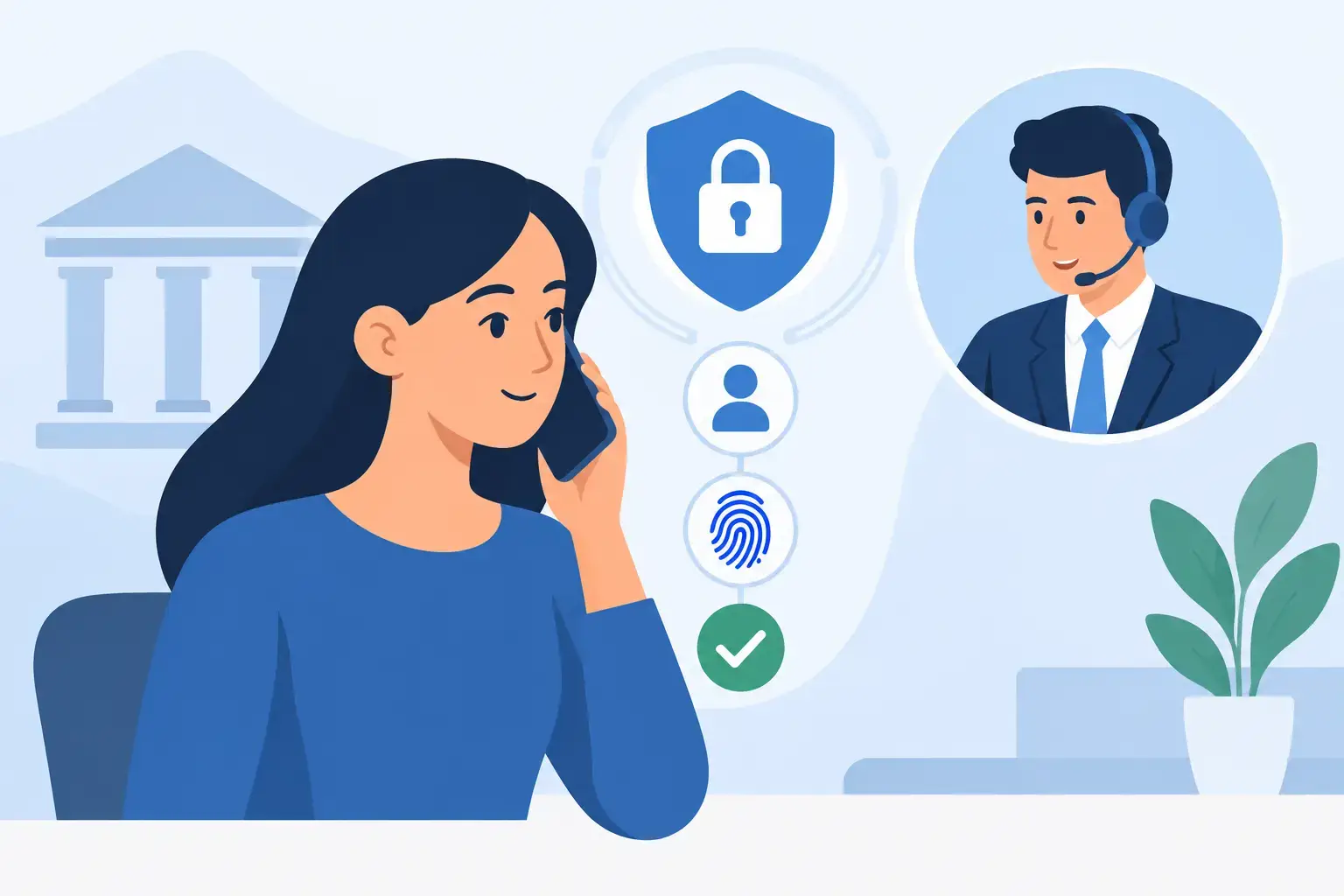
Banking Customer Authentication Guide for Calls
A customer calls because a debit card was declined while they are standing at a checkout counter. Another calls after seeing an unfamiliar transfer. In both moments, speed matters, but so does care. This banking customer authentication guide explains how financial institutions can verify callers with discipline while protecting the dignity of people who need help.
Authentication is not a script hurdle before the real conversation begins. It is part of the customer experience and a frontline fraud control. Done poorly, it can frustrate legitimate customers, expose sensitive information, and create avoidable repeat calls. Done well, it gives agents the confidence to act and gives customers a clear sense that their institution is protecting them.
Why phone authentication requires more than a checklist
Banking customers often call under pressure. They may be traveling, locked out of an account, responding to a fraud alert, or trying to make a payment before a deadline. An agent who sounds suspicious, rushed, or dismissive can turn a difficult situation into a damaged relationship.
At the same time, fraudsters rely on urgency, social engineering, and scattered personal information to persuade an agent to bypass a control. A caller who knows a name, address, or partial Social Security number is not automatically the account holder. Public records, data breaches, and phishing campaigns have made static knowledge-based questions less dependable as a standalone safeguard.
The operating goal is not to make every caller answer the maximum possible number of questions. It is to apply the right level of verification for the request, the customer’s risk profile, and the signals present in the interaction. That approach protects the account without making respectful service feel like an interrogation.
Build a risk-based authentication policy
A strong policy separates low-risk assistance from actions that can create financial loss or expose confidential data. For example, providing branch hours or explaining a general fee policy does not require account-level disclosure. Reviewing transaction details, changing contact information, resetting digital access, issuing a replacement card, or initiating a transfer requires progressively stronger proof.
Your policy should define three practical elements: the action being requested, the authentication level required, and the escalation path when the agent cannot establish confidence. Those rules should be clear enough for a new agent to follow and specific enough to prevent improvisation on high-risk calls.
Match controls to the request
For routine servicing, a combination of non-sensitive account identifiers and approved verification factors may be sufficient. For higher-risk requests, institutions should require stronger controls such as a one-time passcode sent through a pre-established channel, in-app confirmation, or a warm transfer to a specialized fraud team.
There is no universal sequence that fits every bank or fintech. A digital-first institution may rely heavily on app-based confirmation. A community bank serving customers with limited digital access may need carefully designed alternatives. The key is to avoid weaker methods simply because they are faster on a single call. The cost of account takeover, remediation, and lost trust is much higher than a properly managed escalation.
Treat failed authentication as a service moment
When verification fails, agents should not reveal which answer was incorrect or disclose any account details. Yet the language still matters. A respectful response might explain that the institution cannot complete the requested action by phone until it confirms identity, then offer the approved next step.
That may mean visiting a branch, using authenticated digital banking, receiving a one-time code, or speaking with a specialist. Customers should leave the interaction knowing what they can do, not merely what they cannot do. Courtesy and clear direction reduce frustration without weakening security.
The banking customer authentication guide for agent conversations
Authentication works best when agents understand both the procedure and the reason behind it. Certified agents should be trained to follow required language consistently, listen for signs of coercion or fraud, and avoid leading callers toward answers.
Start by setting expectations. A brief statement such as, “To protect your account, I’ll need to verify a few details before I can access it,” prepares the customer without sounding accusatory. The agent should then request only the information allowed for that interaction and record outcomes according to policy.
Agents must never read back full account numbers, passwords, PINs, one-time passcodes, or sensitive information that could help an unauthorized caller. They should not accept a caller’s insistence, a convincing story, or a claimed relationship to the customer as a substitute for required verification. Compassion is essential, but exceptions made in the moment can create serious harm.
For sensitive actions, agents should pause when circumstances do not match the account record or when the caller pressures them to move quickly. Common warning signs include requests to change a phone number before receiving a code, repeated attempts with different answers, instructions from someone heard in the background, or a caller who becomes unusually focused on bypassing a specific control.
A pause is not a failure of service. It is professional judgment. The agent can explain the next approved step with consideration while routing the situation to the right team.
Make authentication easier to deliver correctly
Policies fail when they live only in a compliance manual. Contact center leaders need workflows that make the secure choice the easy choice during a live conversation.
A well-designed desktop should show the authentication status, the permitted account actions, and the next escalation option without forcing agents to search multiple systems. It should also limit what an agent can view before verification is complete. If account data appears too early, even a well-intentioned agent may disclose information while trying to be helpful.
Scripts should support natural speech rather than turn agents into recordings. Give teams approved phrasing for common scenarios, including customers who are upset, elderly customers who need additional time, and Spanish-speaking customers who deserve the same clarity and care as English-speaking callers. Bilingual authentication is not a translation exercise alone. Terms, instructions, and escalation procedures must be accurate in both languages.
Quality assurance should review more than whether an agent asked each question. It should assess whether the agent protected data, avoided disclosure, followed the appropriate risk path, communicated the reason for the process, and offered a clear next step. This produces coaching that improves both compliance and customer confidence.
Measure security and experience together
Average handle time has value, but it can be misleading when used alone. Pressuring agents to shorten authentication may increase transfers, repeat calls, fraud exposure, and customer complaints. A more balanced scorecard shows whether the process is working across security, efficiency, and service quality.
Track authentication completion rates, failure reasons, escalation rates, repeat contacts after failed verification, quality findings, fraud losses connected to phone servicing, and customer sentiment. Review results by call type, channel, language, and agent cohort. Patterns often reveal process issues that broad averages conceal.
For example, a sudden rise in failed authentication for password resets may indicate confusing digital instructions, a system issue, or an active fraud campaign. A high transfer rate among bilingual calls may point to a training gap or an incomplete Spanish-language workflow. The response should be operational, not punitive: clarify the process, improve the tools, and coach the team.
Plan for staffing, training, and escalation coverage
Authentication quality can deteriorate quickly during seasonal peaks, outage events, or a fraud surge. Financial institutions need enough trained coverage to maintain verification standards when call volume rises. Understaffing creates pressure to rush, and rushing is where avoidable errors enter the process.
Outsourced contact center support can be effective when the partner is trained on the institution’s controls, monitored against defined quality standards, and integrated into fraud and escalation protocols. The provider should understand that each interaction represents the client’s reputation, not merely a completed ticket.
Ring & Respect approaches financial-services conversations with that principle in mind: certified work-from-home agents, flexible onshore and nearshore coverage, and a service standard grounded in courtesy and dignity. For banking programs, the right workforce model gives leaders room to scale without compromising the discipline customers expect when their money and identity are at stake.
The best authentication experience leaves a customer with two impressions: their account was treated with care, and the person helping them treated them with respect. That standard is worth building into every call.