How to Hire Remote Agents Without Losing Quality
A sudden increase in call volume can expose every weakness in a customer-contact operation. Hold times rise, experienced team members burn out, and hurried conversations can damage relationships that took years to earn. Knowing how to hire remote agents is not simply a staffing exercise. It is a decision about who will represent your brand when a customer needs clarity, help, reassurance, or a respectful resolution.
For financial services, healthcare, hospitality, retail, and other high-contact organizations, remote agents can provide meaningful flexibility. They can extend coverage, support seasonal demand, provide bilingual English-Spanish service, and reduce the fixed costs of an internal contact center. But remote hiring only works when speed is balanced with standards. The right model protects quality, compliance, and the dignity of every person on the other end of the call.
Start With the Work, Not the Headcount
Before recruiting a single agent, define the work that needs to be done. A request for 20 remote agents can mean very different things depending on whether those agents will handle technical support, appointment reminders, inbound account questions, payment conversations, reservations, sales follow-up, or complex case escalations.
Look closely at call types, contact volume by hour and day, average handling time, systems required, language needs, and escalation paths. Identify what must be handled by an experienced specialist versus what can be supported through structured training and approved scripts. This step prevents an expensive mistake: hiring people for a general customer-service role when the operation actually requires a more specialized skill set.
For example, an agent handling healthcare scheduling needs empathy, accurate documentation, and privacy discipline. An agent supporting collections-adjacent account servicing needs calm communication, policy adherence, and the judgment to recognize when a conversation should be escalated. A sales outreach agent needs product fluency, listening skills, and a consultative approach rather than pressure-driven language.
The goal is not to create a rigid job description. It is to establish clear standards for what respectful, effective performance looks like in each interaction.
How to Hire Remote Agents for Your Operation
The most dependable hiring process evaluates agents in the same conditions they will face once they begin representing your organization. Resumes and interviews matter, but they do not show how a person responds to a frustrated caller, a changing workflow, or a sensitive account question.
Start by building a candidate profile that covers four areas: communication ability, role-specific competence, reliability, and cultural alignment. Communication includes clear speech, active listening, professional writing, and the ability to explain information without sounding rehearsed. Role-specific competence may include CRM experience, collections communication, medical scheduling, technical troubleshooting, or sales qualification.
Reliability is especially significant in a work-from-home environment. Assess whether candidates have a quiet and professional workspace, dependable high-speed internet, appropriate equipment, and the discipline to follow a schedule without constant supervision. These requirements should be verified, not assumed.
Cultural alignment should be practical rather than vague. Ask whether the candidate can treat every customer with courtesy, even when the conversation is difficult. Evaluate whether they can accept coaching, follow documented procedures, protect confidential information, and communicate with consideration across different backgrounds and circumstances.
A structured interview should include scenario-based questions. Present a realistic situation: a customer disputes a charge, cannot understand a policy, has missed a payment, or needs urgent assistance. Then listen for the candidate’s process. Strong agents acknowledge the customer’s concern, gather accurate information, explain the next step plainly, and avoid making promises they cannot keep.
Role-play is equally valuable. It reveals tone, composure, listening habits, and the ability to apply feedback in real time. For bilingual roles, assess both languages through live conversation, not only a written claim of fluency. A person may speak Spanish conversationally while lacking the vocabulary or confidence needed for a regulated account discussion.
Choose the Right Remote Staffing Model
Businesses generally have two paths: hire remote agents directly or work with a managed workforce partner. Neither is automatically better. The right choice depends on your internal capacity, timeline, compliance requirements, and expected scale.
Direct hiring offers more immediate control over recruiting, payroll, training, and team culture. It can make sense when you have a stable volume forecast, mature remote-management practices, and enough internal leadership to coach and monitor a distributed team. The trade-off is that your organization carries the full burden of sourcing, screening, onboarding, workforce scheduling, technology support, and replacement hiring.
A managed contact-center or business process outsourcing partner can be a stronger fit when speed and flexibility matter. The partner can provide certified work-from-home agents, recruiting infrastructure, quality assurance, operational leadership, and the ability to scale a team up or down as demand changes. This is particularly useful for organizations that need rapid deployment, bilingual coverage, extended hours, or a blended nearshore and onshore workforce.
The decision should not be based on hourly cost alone. A lower rate has little value if it produces inconsistent attendance, poor documentation, repeat contacts, compliance exposure, or consumer complaints. Consider total operating cost, including the management time and brand risk associated with weak customer conversations.
Make Training Specific to Your Brand
Remote agents cannot represent your organization well if training only covers systems and scripts. They need context. Explain who your customers are, what they may be experiencing when they call, what promises your brand makes, and where agents have the authority to solve a problem.
Training should combine product knowledge, workflow instruction, compliance guidance, and communication practice. For sensitive industries, include clear procedures for authentication, privacy, payment handling, documentation, disclosures, and escalation. For every industry, teach agents how to reduce friction: use plain language, confirm understanding, avoid interrupting, and give customers a realistic next step.
Scripts can help create consistency, especially in regulated or high-volume environments. However, a script should guide the conversation, not erase humanity from it. Customers can tell when an agent is reading through a problem rather than listening to it. Give agents approved language and clear boundaries, then coach them to use judgment within those boundaries.
A respectful standard also needs to be visible in the quality program. Review calls for accuracy and efficiency, but also for tone, patience, ownership, and clarity. An interaction can meet a handle-time target and still leave a customer feeling dismissed. That outcome may cost more than an additional minute on the call.
Build Security and Accountability Into the Remote Environment
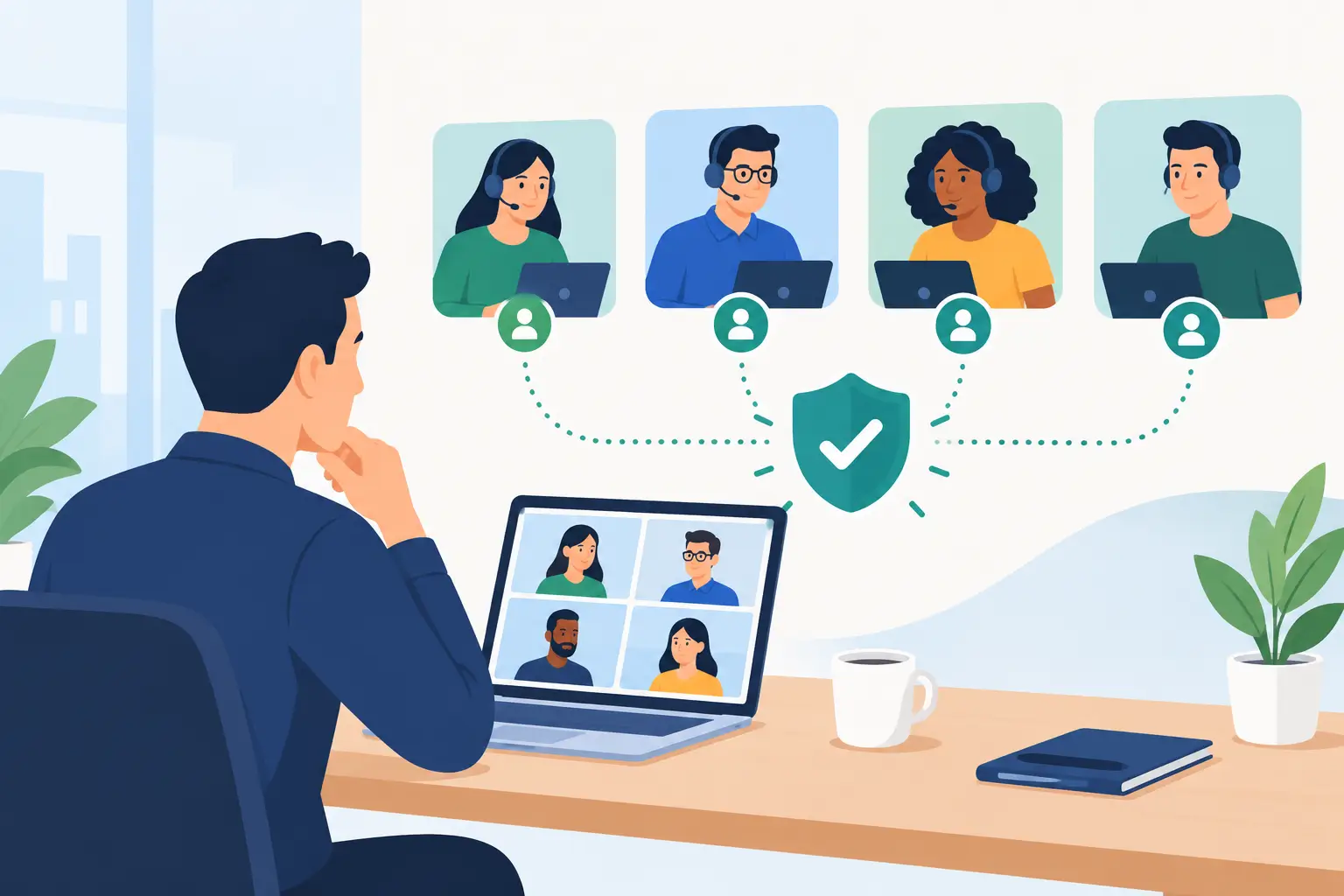
Remote staffing introduces operational risks that must be managed deliberately. Agents may be handling personal data, financial information, healthcare details, or account records from home. Security controls should be designed before launch, not added after an incident.
Establish requirements for secure devices, access controls, multifactor authentication, approved networks, clean-desk practices, and secure call handling. Limit system access according to job role, monitor for unusual activity, and maintain documented incident-response procedures. If recordings or screens are reviewed for quality assurance, explain the purpose and apply the process consistently.
Accountability should extend beyond technology. Set clear expectations for attendance, schedule adherence, documentation accuracy, quality scores, and escalation compliance. Remote work does not require intrusive supervision, but it does require visible performance standards and timely coaching.
Measure What Customers Actually Experience
A remote agent program should be measured through a balanced set of operational and customer-centered indicators. Service level, answer rate, average handle time, conversion rate, and collections performance can show whether the operation is functioning efficiently. Quality scores, repeat-contact rate, complaint patterns, customer satisfaction, and escalation volume reveal whether it is functioning well.
Review these measures together. An agent who ends calls quickly but drives repeat contacts may be creating more work for the business. A team with strong sales results but rising complaints may be using an approach that places short-term revenue above long-term trust.
Regular calibration is essential when internal leaders and an outsourcing partner both review performance. Use the same call standards, agree on what counts as a quality failure, and discuss trends instead of reacting only to isolated mistakes. This creates a fairer environment for agents and clearer accountability for leadership.
Select Partners and Leaders Who Protect Your Reputation
Whether you hire directly or engage a provider such as Ring & Respect, ask how the operation recruits, certifies, coaches, and retains agents. Request a clear explanation of quality assurance, security practices, bilingual capabilities, supervisory ratios, reporting, and escalation management. A credible partner should be able to describe not only its staffing capacity, but also how it protects the client experience when calls become challenging.
Pay attention to values in practice. Respect is not a slogan reserved for a company website. It appears in how agents are coached after an error, how customers are addressed during difficult account conversations, and how leaders respond when performance data reveals a problem.
The best remote agents do more than fill a queue. With the right hiring standards, training, and leadership, they become a dependable extension of your organization – helping customers feel heard while helping your operation grow with discipline and care.